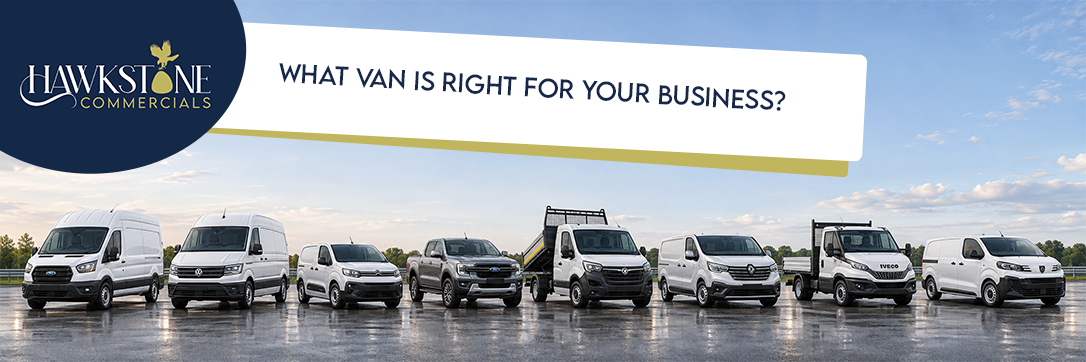
What Van is Right For Your Business?
From vehicle size and payload to fuel efficiency and running costs, we explore the factors UK businesses should consider when choosing a commercial vehicle.
Choosing the right van is an important decision for any business. Whether you're a sole trader looking for your first commercial vehicle or an established company expanding its fleet, your choice can have a significant impact on your day-to-day operations and expenditure.
With numerous manufacturers, models, sizes and configurations available, however, identifying the most suitable option isn't always straightforward.
The requirements of businesses can differ considerably. A local electrician may need secure storage for tools and equipment, while a landscaping company might require a vehicle capable of carrying and unloading heavy materials.
So, what should businesses consider when choosing a van, and how can they identify the vehicle best suited to their requirements?
Does Van Size Matter?
One of the first decisions when purchasing a commercial vehicle is determining how much space and carrying capacity your business requires.
Small, medium and large vans each offer different advantages, and choosing the largest available vehicle isn't necessarily the most practical or economical decision.
Small Vans
Small vans are often suitable for businesses transporting relatively lightweight equipment or making frequent journeys in towns and cities.
Their compact dimensions can make parking and manoeuvring easier, particularly in residential areas and locations with limited access. As they usually weigh less and have smaller engines, they’re more economical, too.
However, their restricted load space and carrying capacity may make them unsuitable for businesses transporting bulky equipment or substantial quantities of materials.
Medium Vans
Medium-sized vans provide a balance between load capacity and everyday practicality.
They can be particularly suitable for tradespeople, maintenance businesses and delivery operators who require more storage than a compact van provides, without needing the dimensions of a larger commercial vehicle.
Depending on the model and configuration, medium vans may also offer options such as additional seating, roof racks and specialist storage solutions.
Large Vans
For businesses regularly transporting bulky goods, heavy equipment or substantial quantities of materials, a large van may be more suitable.
Figures published by the Society of Motor Manufacturers and Traders (SMMT) show that vans weighing over 2.5 tonnes and up to 3.5 tonnes accounted for 66.7% of new UK light commercial vehicle registrations in 2025, making this the largest market segment.
Although these weight categories don't correspond exactly to the small, medium and large descriptions used by manufacturers, the figures demonstrate the popularity of higher-weight commercial vehicles.
Large vans can provide valuable additional load space, but buyers should consider whether this capacity is necessary. A larger vehicle may cost more to purchase and operate, while its dimensions can make access to some locations more difficult.
Ultimately, the most suitable size depends on what your business needs to transport and where the vehicle will operate.
Load Space vs Payload: What's the Difference?
While vehicle size is important, businesses should also understand the distinction between load space and payload.
These measurements describe different aspects of a commercial vehicle's carrying capabilities.
Load space refers to the physical volume available for transporting goods or equipment, typically measured in cubic metres (m³).
Payload refers to the weight a vehicle can carry within its maximum permitted gross weight. The usable allowance depends on the vehicle's specification and must accommodate occupants, equipment and other relevant weight.
A van with generous load space won't necessarily have the payload capacity required to transport particularly heavy materials.
For example, a business transporting lightweight packaging may benefit from a large cargo area without requiring an especially high payload. Conversely, a contractor carrying dense building materials may need to prioritise carrying capacity over internal volume.
According to the Driver and Vehicle Standards Agency (DVSA), a van's maximum permitted gross weight includes the vehicle itself, driver, passengers, fuel and load. Exceeding the permitted vehicle or axle weight can affect safety and result in enforcement action.
Businesses should therefore consider both the dimensions and weight of their typical loads before choosing a vehicle.
It's also worth accounting for equipment added after purchase. Racking, storage systems, toolboxes and other modifications can reduce the available payload.
Which Type of Commercial Vehicle Does Your Business Need?
Vehicle size isn't the only consideration. Choosing the right body style can make a substantial difference to how efficiently a van supports everyday operations.
Several configurations are available, each designed to accommodate different requirements.
Panel Vans
Panel vans provide an enclosed cargo area, offering protection from the weather and allowing goods and equipment to be stored securely.
They're a popular option for electricians, plumbers, couriers and other businesses transporting tools, equipment or packaged goods.
Tippers
Tippers feature a load bed that can be raised to assist with unloading loose materials.
They can be particularly practical for landscaping, groundwork and construction businesses regularly transporting materials such as soil, gravel or aggregates.
Buyers should pay particular attention to the vehicle's payload, as the tipper body and lifting mechanism contribute to its weight.
Dropsides
Dropside vehicles feature a flat load bed with sides that can be lowered or removed, making loading and unloading bulky materials easier.
This can make them suitable for businesses transporting items such as building supplies, equipment and other loads requiring convenient side access.
Pickups
Pickup trucks combine an open load bed with the passenger accommodation of a conventional vehicle, making them a versatile option for businesses requiring both carrying capacity and everyday practicality.
Many pickups offer four-wheel drive and substantial towing capacity, making them suitable for transporting equipment and accessing challenging locations. However, businesses should consider payload, load security and whether the open load bed provides sufficient protection for their goods and equipment.
Luton Vans
Luton vans feature a large, enclosed box-shaped cargo area that typically extends over the driver's cab, providing additional storage space for bulky goods.
They're particularly suitable for removals companies, furniture delivery businesses and organisations regularly transporting large or awkwardly shaped items.
Their generous load space makes them practical for carrying substantial volumes of goods, while some models feature tail lifts to assist with loading and unloading heavier items. However, buyers should consider the vehicle's payload capacity, particularly where additional equipment such as a tail lift increases its unladen weight.
The key consideration is how the vehicle will be used. A business regularly unloading loose materials may benefit more from a tipper than a conventional panel van, while a company transporting valuable tools may prioritise enclosed storage.
How Should Mileage and Running Costs Influence Your Decision?
The purchase price of a commercial vehicle is only one part of its overall cost.
Businesses should also account for fuel or electricity, servicing, maintenance, insurance, depreciation and other operating expenses.
The importance of these costs will vary depending on how frequently and where the vehicle is used.
The DfT's 2019–20 van survey found that 51% of vans in Great Britain stayed within 15 miles of their base on a typical day.
Although this is historical data, it illustrates why local operating requirements deserve consideration alongside long-distance travel.
A business making frequent short journeys may have different priorities from one travelling hundreds of miles each week.
For example, a compact van may offer practical advantages for frequent urban deliveries, while a business making longer journeys with heavier loads may prioritise carrying capacity, comfort and suitable powertrain options.
Should Your Business Consider an Electric Van?
Electric commercial vehicles are becoming an increasingly prominent part of the UK market.
According to SMMT figures for January–September 2026, battery-electric light commercial vehicles accounted for 10.8% of new registrations, compared with 9.1% during the same period in 2025.
For businesses operating predictable routes and with access to convenient charging, an electric van may be worth considering.
However, buyers should assess the vehicle's real-world range, charging arrangements, payload, purchase price and expected running costs.
Diesel and other powertrain options may remain more practical for some businesses, particularly where driving patterns, payload requirements or access to charging make electrification difficult.
Rather than choosing a powertrain purely on purchase price or popularity, businesses should compare the expected costs and practical implications over their intended ownership period.
It's also worth checking whether the vehicle meets the emissions requirements of areas where it will operate. Under England's charging Clean Air Zone rules, diesel vans generally need to meet Euro 6 standards and petrol vans Euro 4 standards to avoid applicable emissions charges. Other local schemes may have different requirements.
Case Study: Choosing the Right Van for Three Different Businesses
To demonstrate how commercial vehicle requirements vary, consider three hypothetical UK businesses looking to purchase a new van.
These examples are illustrative rather than actual Hawkstone Commercials customers.
Business One: A Local Delivery Company
The requirement: A small delivery business transports lightweight parcels between customers in a busy urban area.
Its drivers frequently stop to make deliveries and regularly navigate narrow roads, residential streets and restricted parking areas.
What matters most?
The business needs sufficient space for its daily parcel volume, but manoeuvrability and convenient loading access are equally important.
A large van may provide more capacity than the company requires, potentially adding unnecessary purchase and operating costs.
Potential solution: A small or medium panel van, depending on the volume and dimensions of the parcels being transported.
An electric model may also be worth evaluating if the business operates predictable daily routes and has access to suitable charging.
Business Two: An Electrical Contractor
The requirement: An electrical contractor needs a vehicle to transport tools, ladders, cable, equipment and materials between customer sites.
The van will also function as a mobile storage space, with the contractor accessing tools and equipment throughout the working day.
What matters most?
Secure storage, adequate payload, accessibility and practical internal dimensions are essential.
While a compact van may accommodate basic tools, larger equipment and longer materials could make additional load space necessary.
Potential solution: A medium or large panel van, depending on the contractor's equipment and typical load requirements.
Business Three: A Landscaping Company
The requirement: A landscaping contractor transports tools, equipment and materials between residential and commercial sites.
The company regularly needs to carry soil, aggregates and other heavy or loose materials.
What matters most?
Payload capacity and ease of unloading are particularly important.
Although a conventional panel van could transport certain equipment, it may not provide the most practical arrangement for regularly unloading loose materials.
Potential solution: A tipper or dropside vehicle, with the final choice depending on how materials are loaded and unloaded, the weight of typical loads and whether additional passenger accommodation is required.
What Do These Examples Demonstrate?
Despite all three businesses requiring commercial vehicles, their operational priorities differ substantially.
For the delivery company, vehicle dimensions and accessibility may be most important. The electrical contractor needs to balance carrying capacity with secure and organised storage. Meanwhile, the landscaping company must pay close attention to payload and unloading requirements.
There is no universally suitable commercial vehicle. The right choice depends on understanding the tasks the vehicle must perform.
What Else Should You Consider Before Buying a Van?
Before committing to a particular model, businesses should assess their likely future requirements alongside their immediate needs.
For example, a company expecting to expand its operations may want additional carrying capacity, while a sole trader may prioritise keeping purchase and operating costs manageable.
Buyers should also consider the vehicle's warranty, available servicing support, finance options and any modifications required for their work.
Where finance is being considered, it's important to evaluate both the regular payments and the overall cost of the agreement, including any applicable restrictions or end-of-contract obligations.
Making these comparisons before purchasing can help businesses avoid choosing a vehicle that is unnecessarily expensive or unsuitable for everyday operations.
Finding the Right Van for Your Business
Choosing the right commercial vehicle involves more than comparing prices and manufacturers.
Vehicle size, payload, body style, running costs and daily mileage can all influence which van is most suitable.
The most economical choice isn't necessarily the cheapest vehicle to purchase, nor is the largest van automatically the most practical. Businesses should focus on finding a vehicle that can meet their operational requirements efficiently and reliably.
At Hawkstone Commercials, we understand that different businesses have different transport needs.
Our experienced team can help you identify a suitable commercial vehicle, compare available options and explore flexible finance arrangements through our panel of lenders, subject to status.
Whether you're a sole trader buying your first van or a growing business expanding its fleet, we're here to help.
Explore our vans for sale or contact our team to discuss your requirements.
